paper / / 2 min read / Redomic Labs
NeuThera wins third at the NVIDIA and ArangoDB Hackathon
A drug-discovery pipeline that generates candidate molecules from scratch, validates them, and runs end to end as an agentic workflow. NeuThera placed third and took a five thousand dollar prize.
- research
- drug-discovery
- graphrag
- agents
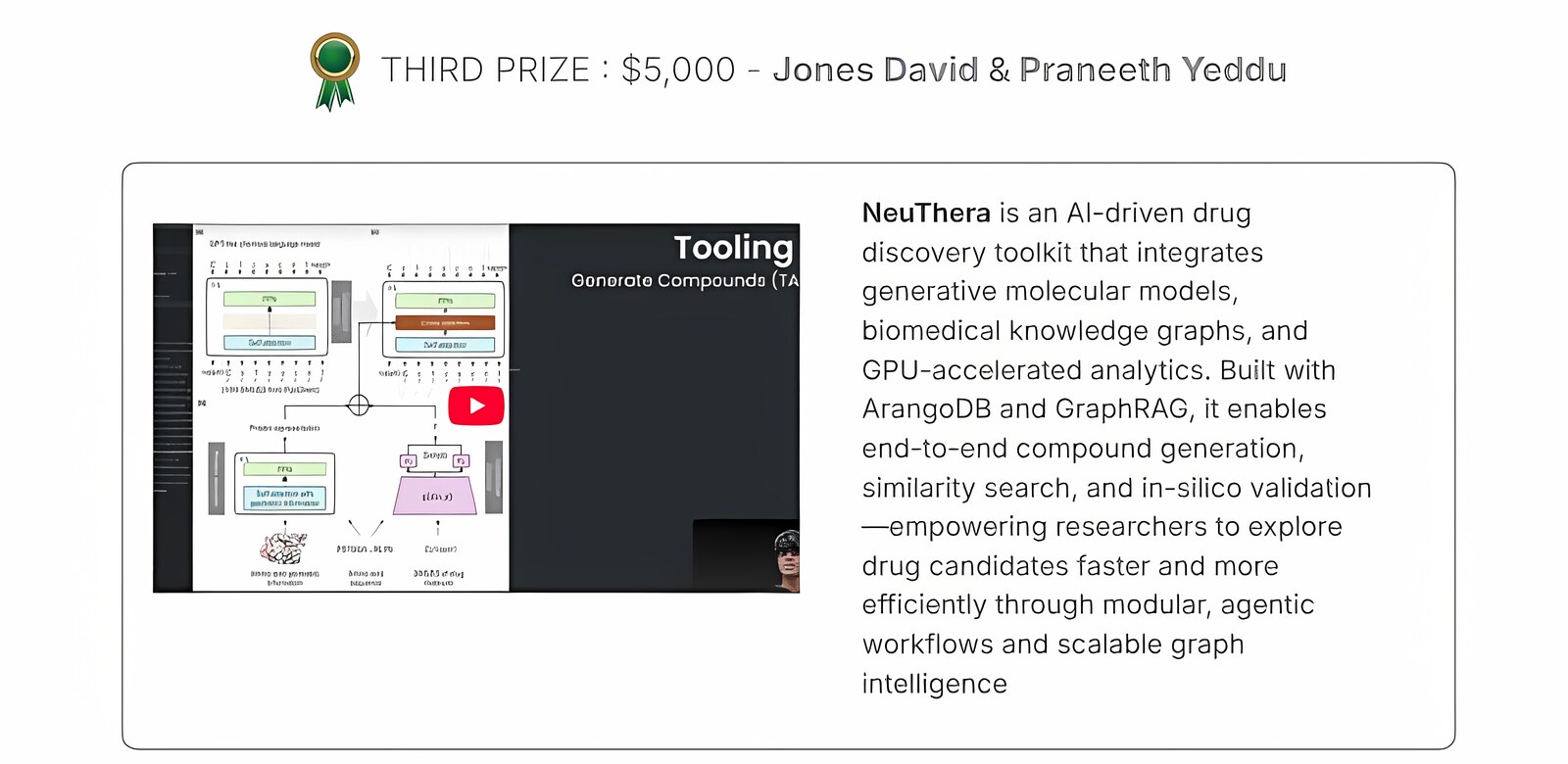
NeuThera placed third at the NVIDIA and ArangoDB Hackathon and earned a five thousand dollar prize. It is an AI-driven drug discovery toolkit that folds generative molecular models, a biomedical knowledge graph, and GPU-accelerated analytics into one end-to-end pipeline: compound generation, similarity search, and in-silico validation, all in a single pass.
Where the idea came from
The biomedical field gives away a remarkable amount of ground truth. Structural databases publish terabytes of protein data openly, and molecules already have a compact string representation in SMILES. If a model can learn protein folding from amino acid sequences, then learning to generate viable compounds from the same kind of structured data does not look categorically harder. It looks like a sequence problem with an unusually good supply of training signal.
So NeuThera runs the whole path as one workflow: target selection, compound generation, affinity prediction, and docking validation, stitched together and driven by an agent rather than a person moving data between tools by hand. Generative chemistry models propose the molecules, GraphRAG over a biological knowledge graph in ArangoDB grounds the retrieval, and the agentic layer lets a researcher drive the system in plain language.
A toolkit, not a one-off
The aim was never a single hit compound. It was a modular, open toolkit a researcher could point at their own target, with the boring but essential gates in place: docking and affinity checks that filter generated molecules on more than plausibility. What placed at the hackathon is the first working version of that idea.
The interesting question is how much of a discovery pipeline can be trusted to run unattended before a human has to judge whether a compound is worth pursuing.
Redomic Labs