paper / / 3 min read / Jones David, Shreya Ghosh
IntelliCode accepted to EACL 2026
Most LLM tutors forget you the moment a session ends. IntelliCode gives the tutor a memory of the learner, and in our trials that moved mastery 6.3 times faster than a stateless baseline. The work is accepted to EACL 2026.
- research
- edtech
- multi-agent
- eacl-2026
Ask an AI tutor for help twice and it meets you as a stranger both times. It has no memory of your learning journey, so it cannot know what you have mastered, where you keep slipping, or when you are due for review. Our paper, IntelliCode: A Multi-Agent LLM Tutoring System with Centralized Learner Modeling, closes that gap, and it has been accepted to EACL 2026.
The acceptance is to the System Demonstrations track. The preprint went up on arXiv on 21 December 2025 under cs.AI: six pages of main content, six figures, and appendices.
A tutor built around the learner, not the message
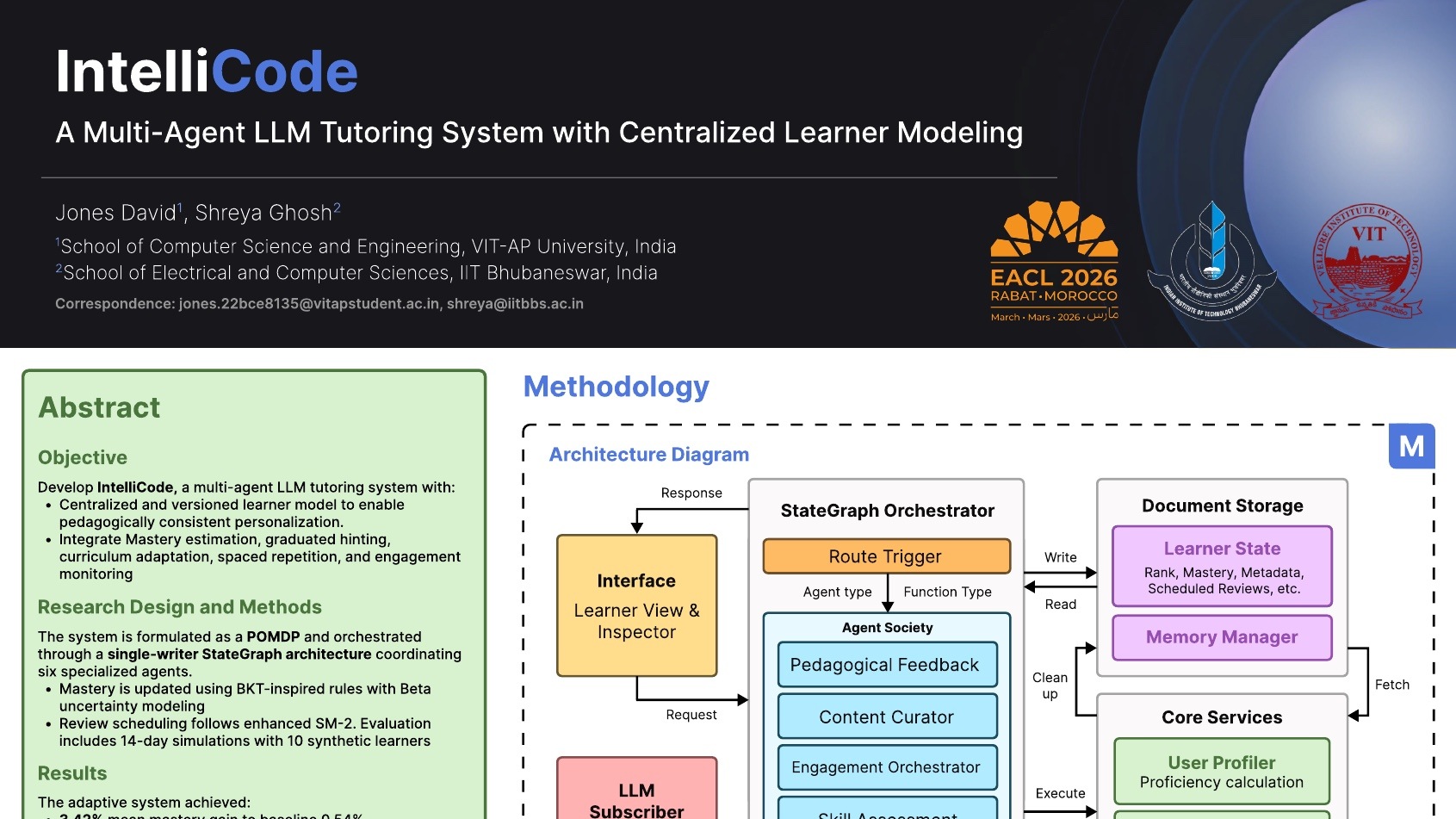
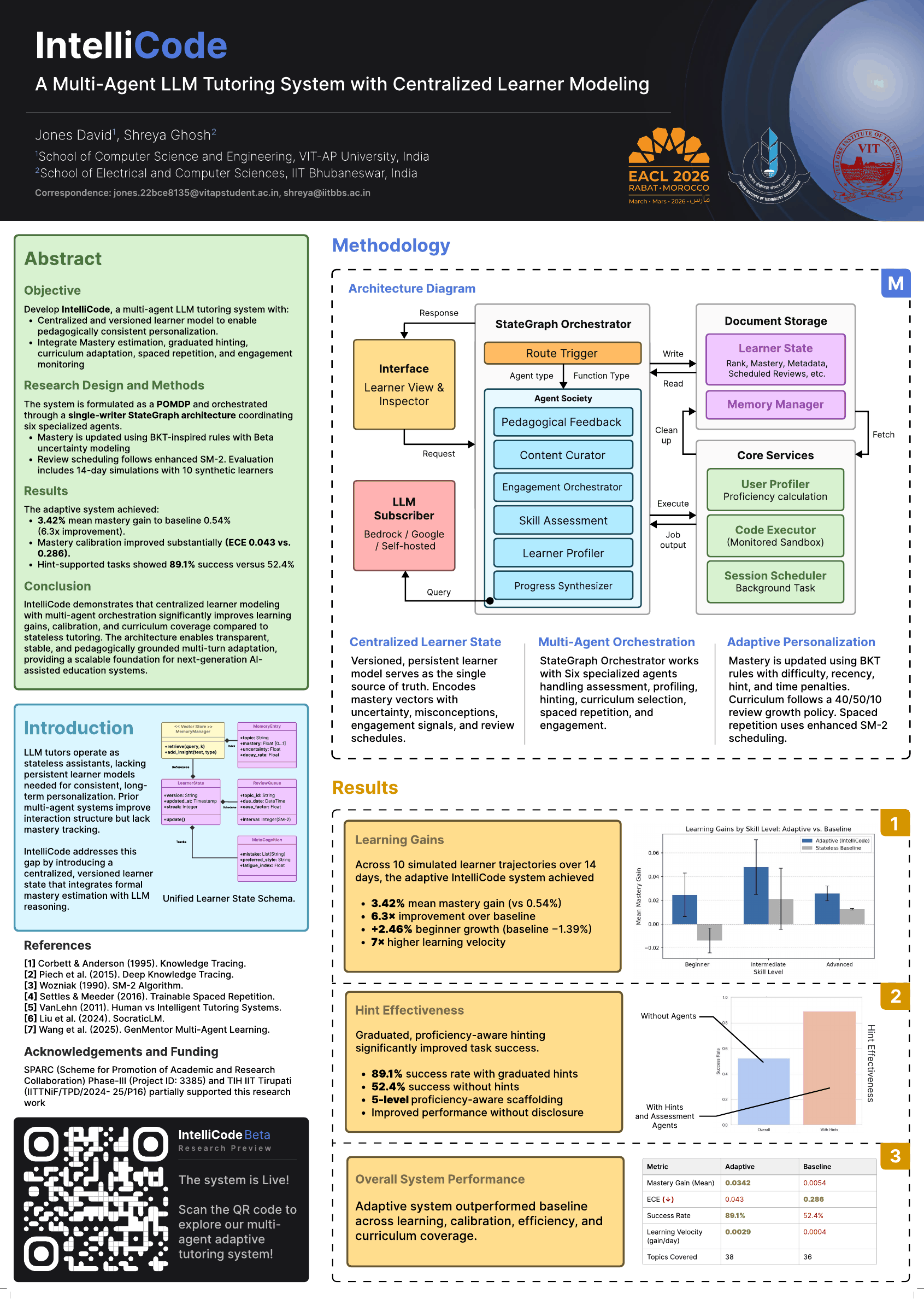
IntelliCode is built around a centralized, versioned learner state that carries mastery estimates, misconceptions, review schedules, and engagement signals across sessions. The system is formulated as a POMDP and orchestrated through a single-writer StateGraph, so six specialized agents, for skill assessment, learner profiling, graduated hinting, curriculum selection, spaced repetition, and engagement monitoring, can each act as a pure transformation over one shared state without stepping on each other.
That design is what makes the tutor legible rather than a black box. Mastery is updated with knowledge-tracing rules under explicit uncertainty, reviews follow an enhanced SM-2 schedule, hints are proficiency-aware, curriculum adaptation is dependency-aware, and prompting is safety-aligned. The tutor can account for what it believes about a learner and why, which is the difference between a system you can trust with a student and one you cannot.
What the trials showed
We evaluated IntelliCode against a stateless baseline over fourteen-day simulations with ten synthetic learners. The adaptive system did not just edge ahead. It changed the shape of the outcome.
- 6.3 times the mean mastery gain: 3.42 percent against the baseline's 0.54 percent, with beginners growing 2.46 percent where the baseline went backwards.
- Far better calibration: an expected calibration error of 0.043 against 0.286, so the tutor's confidence in what a learner knows actually tracks reality.
- Graduated hints that teach rather than tell: 89.1 percent task success with hints against 52.4 percent without.
What the demo shows
The end-to-end workflow follows a learner through a single DSA problem: they attempt it, receive a conceptual hint when stuck rather than the answer, submit a corrected solution, and immediately see their mastery update and a personalized review interval. Small loop, but it is the whole thesis in miniature: the tutor is reasoning about the learner, not just the last message.
IntelliCode is a demonstration of a broader idea we keep returning to. Persistent learner modeling, orchestrated multi-agent reasoning, and principled instructional design can be combined into an AI tutor that is transparent and reliable, not merely fluent. The paper, a live demo, and a short walkthrough are linked below.